A complete December planning guide for hosts who want clarity, accuracy, and zero last-minute stress.
Why December Hosting Requires Better Preparation
Christmas gatherings last longer, involve heavier meals, and often include wider age groups, which makes alcohol planning different from a standard weekend party. Shelves empty faster as Christmas approaches, and prices often spike in the final 10–12 days of the month. Planning now ensures better variety, better pricing, and less chaos. You might even consider buying in bulk to lock in pricing and stock up early, especially if you qualify for wholesale rates.
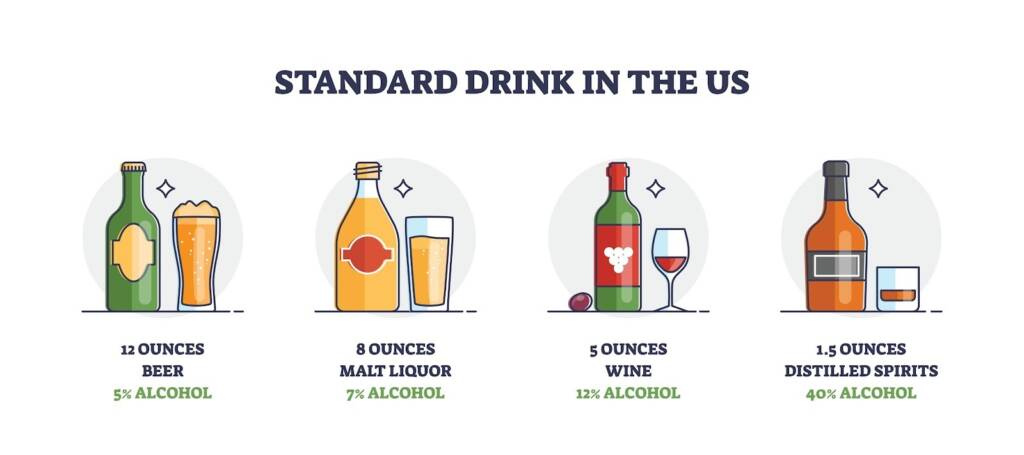
Before getting into the math, it helps to base all calculations on official standard drink definitions. For consistency and responsible planning, a standard drink is generally accepted as:
- Beer: 12 oz. (5% ABV)
- Wine: 5 oz. (12% ABV)
- Spirits: 1.5 oz. (80-proof or 40% ABV)
These clear baselines ensure your math is consistent and realistic, regardless of the drink type.
How Many Drinks Will Each Guest Actually Have?
Holiday parties have a relaxed, steady pace. Guests usually eat more, stay longer, and switch between drinks throughout the night. That means you need a drink estimate based on behaviour, not random guesses.
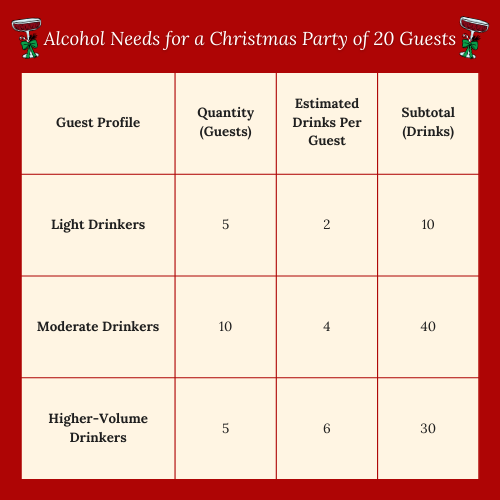
Estimated Alcohol Needs for a 20-Guest Christmas Party
The following table details the estimated baseline drink requirement based on different guest consumption profiles.
🧮 Calculation of Total Drinks
The total baseline drinks are calculated by summing the subtotal for each profile:
1. Calculate Subtotals:
- Light Drinkers: 5 guests x 2 drinks/guest = 10 drinks
- Moderate Drinkers: 10 guests x 4 drinks/guest = 40 drinks
- Higher-Volume Drinkers: 5 guests x 6 drinks/guest = 30 drinks
2. Sum the Subtotals:
Total Drinks = (10 drinks) + (40 drinks) + (30 drinks)
Total Drinks = 80 drinks
This clarifies that 80 drinks is the required baseline for the 20 guests based on the established profile.
Why Christmas Parties Need Different Ratios
Holiday parties require different alcohol ratios than typical gatherings because they lean more toward wine and cocktails. These drinks pair well with Christmas food, feel more seasonal, and suit slower-paced gatherings. While beer remains relevant, especially for younger guests, spirits and wine generally take the lead.
The recommended ratios for dividing your total estimated drinks (like the 80-drink baseline) are as follows:
- Younger or Casual Groups: Allocate 45% of drinks to Beer/Cider, 25% to Wine/Sparkling, and 30% to Liquor/Cocktails.
- Mixed Age (20s–40s) Groups: Distribute the drinks as 35% Beer/Cider, 35% Wine/Sparkling, and 30% Liquor/Cocktails.
- Family / Older Crowds: Plan for 20% Beer/Cider, 50% Wine/Sparkling, and 30% Liquor/Cocktails.
Using the earlier 80-drink baseline for a mixed-age crowd (35% Beer, 35% Wine, 30% Liquor):
- Beer/Cider (28 drinks): Approximately 28 cans/bottles.
- Wine/Sparkling (28 drinks): Approximately 9 to 12 standard 750ml bottles (assuming 5-6 servings per bottle). If you need that many bottles, check out the benefits of buying wine by the case.
- Liquor/Cocktails (24 drinks): Approximately 3 to 5 standard 750ml bottles of base spirits (depending on if they are mixed or neat).
The Smart Formula for Any Christmas Party
Use this simple calculation to determine your final inventory:
Total Drinks ➡️ (Guest Count ✖️ Average Drinks) ✖️ 1.15 Buffer
The 1.15 Factor: This accounts for the necessary buffer and waste, which is higher during busy holiday events. It covers:
- Abandoned Glasses: Guests misplace or abandon glasses while chatting or eating.
- Switching Drinks: Guests frequently switch from wine to cocktails, leaving unfinished drinks.
- Heavier Early Pours: Hosts and guests pour drinks more generously at the start.
- Unexpected Attendees/Waste: Covers a few extra people and unavoidable spillage.
Example:
20 guests ✖️ 4 drinks ✖️ 1.15 buffer ➡️ 92 total drinks
Now allocate those 92 drinks using your chosen ratio. Planning for this 15% waste is normal and eliminates stress.
Understanding the Christmas Drinking Pace
Most Christmas parties follow the same predictable drinking rhythm, which you can use to manage your bar stock efficiently.
- Hour 1 (Warming Up): Guests will consume 1.5 to 2 drinks. You should recommend drinks like sparkling wine, cider, or light spritzers during this initial period.
- Hours 2–3 (Peak Social Window): The consumption rate settles to about 1 drink per hour. This is the ideal time to feature cocktails, mixed drinks, and red wine with dinner.
- Hours 4–5 (Slowing Down): Guests slow down to 0.5 to 1 drink per hour. They often lean toward warm beverages like mulled wine, hot toddies, or digestifs (for example, brandy or port).
- Hour 6+ (Light Sipping): Consumption turns to light sipping. At this point, offerings should include coffee, dessert wine, or quality zero-proof options.
Why Batched Cocktails Are a Christmas Essential
Christmas gatherings are typically heavy on food and conversation, meaning no host wants to spend the entire night making individual drinks. Batching your cocktails simplifies service, reduces mixing errors, and ensures consistent quality for all guests.
Rule of Thumb for Batches:
- 1 gallon of punch or mixer is approximately equal to 20 standard drinks.
For 15–20 guests, having two gallons of a seasonal punch or sangria, alongside your standard wine and beer stock, will comfortably cover the peak hours of the party.
Logistics Most Hosts Forget
These small details prevent chaos and cut down on unnecessary waste:
- Ice: Plan for 1.5 lbs of ice per person. Yes, even in winter, cocktails require a lot of ice.
- Glassware: Use drink markers or simple tags to label glasses to cut drink waste by up to 25%.
- Storage: Prepare fridge and freezer space two days in advance. Use insulated coolers or porch-cold storage for overflow beer and mixers.
- Mixers: Mixers (soda, tonic, juice) run out faster than spirits. Overbuy these, especially cranberry and ginger ale.
🎁 Your Quick Christmas Buy-Planning Flow
Use this simplified flow to make quick purchasing decisions based on two factors:
1. Based on Serving Food:
- Yes: If you are serving food, estimate approximately 4 drinks per person.
- No: If you are not serving food, estimate approximately 5 drinks per person.
2. Based on Gathering Type and Age Profile:
- Dinner / Sit-Down Party: Use a ratio of 25% beer, 45% wine/sparkling, and 30% liquor.
- Friends / High-Energy Party: Use a ratio of 40% beer/seltzers, 20% wine, and 40% liquor.
- Age Profile Adjustment: If the group is mostly under 30, increase beer and seltzers by 15%. If the group is mostly over 40, increase wine and warm cocktails.
Conclusion
The secret to a great Christmas party is early, accurate preparation. When you understand how your guests drink, use realistic math, and stock up before the holiday rush, your gathering runs smoothly from the first toast to the final goodnight. Plan early, buy smart, and create a Christmas night everyone remembers for the right reasons. And remember, if you need professional catering or bar services for your large holiday event, you can always rely on the ABC Store Restaurant services.