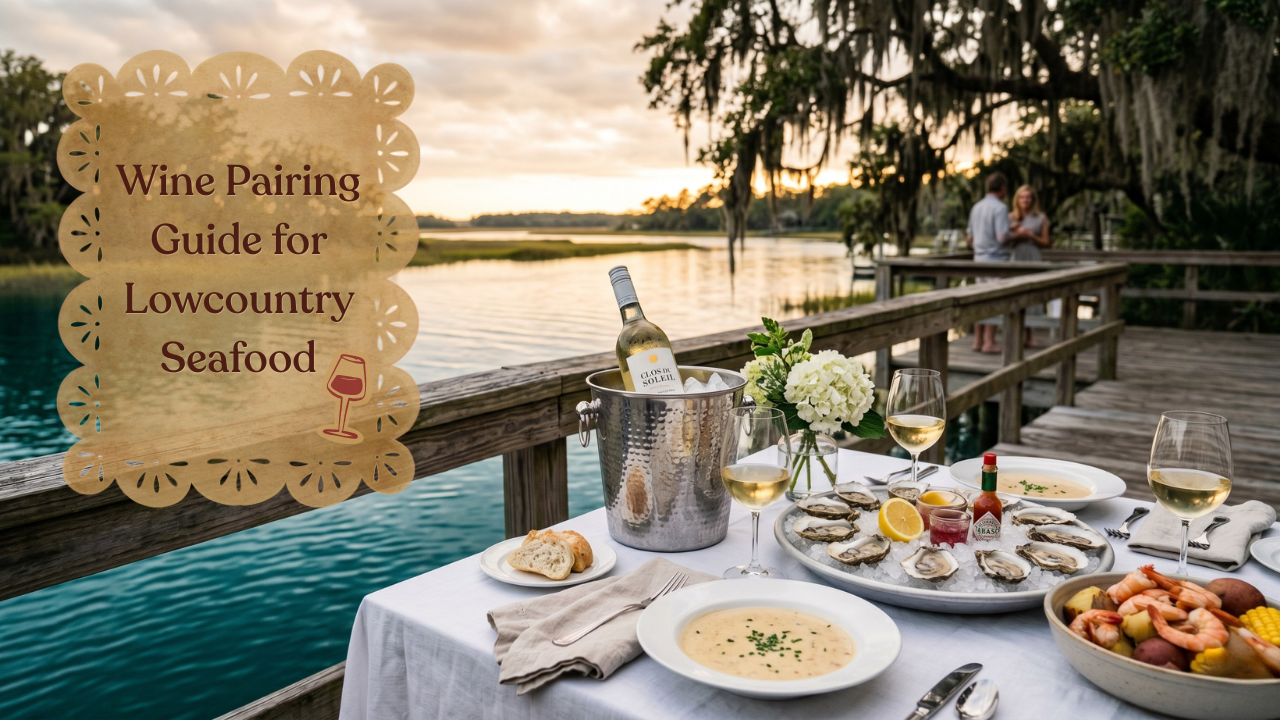
The rule “white wine with fish” is correct approximately 60% of the time. The other 40% — that’s where Charleston’s cuisine lives.
TLDR Summary For You
What this article answers: Specific wine pairings for shrimp and grits, she-crab soup, Lowcountry boil, grilled fish, oysters, and crab; the biochemistry behind acid-fat and tannin-protein interactions; the 20-minute wine rule; a complete seafood-wine pairing chart; and where to find these bottles in Charleston and Mt. Pleasant.
Bottom line: High-acid whites (Albariño, Muscadet, Grüner Veltliner, dry Riesling) and brut sparkling wines solve most Lowcountry seafood pairings. The exceptions are specific, and this guide covers every one of them.
Lowcountry cuisine is built on three flavor axes that most wine pairing guides never acknowledge simultaneously: intense brine from shellfish; the fat of butter, cream, and pork products; and the heat of Old Bay, cayenne, and hot sauce. A wine that resolves one axis often destroys another. This is precisely why a generic “Chardonnay with seafood” instruction fails at a shrimp boil: the wine’s oaky fat meets the sausage’s fat, and you get no contrast, no brightness, nothing to lift the meal off the palate.
Pairing for Lowcountry food requires understanding what the wine must do in the mouth, not simply what color it is.
The Biochemistry of a Great Pairing
Acidity in wine functions identically to a squeeze of lemon over a fatty dish: both introduce hydrogen ions that interact with the salivary proteins responsible for fat perception, mechanically cleansing the palate and resetting the tasting threshold for the next bite. High-acid wines (Sauvignon Blanc, Albariño, Muscadet, Champagne, Grüner Veltliner) therefore pair well with any seafood preparation that involves butter, cream, rich sauces, or fried coatings.
Tannins, the polyphenolic astringent compounds present in red wines extracted from grape skins, seeds, and oak, react differently: they bind to proteins. In a fatty protein like a ribeye steak, this binding softens the tannin’s grip on your palate. In a delicate white fish or briny shellfish, however, the tannin has nothing substantial to bind to; it dominates the interaction and the fish tastes metallic. This is the real reason most red wines fail with delicate seafood, not tradition, not superstition. Chemistry.
The exceptions are deliberate and logical. Light-bodied, low-tannin reds aged in neutral vessels (Beaujolais Cru, some Pinot Noir, Schiava, and Zweigelt served chilled) can work beautifully alongside fatty fish like salmon, tuna, and swordfish precisely because their softer phenolic structure doesn’t overpower the protein. Charleston’s own sommelier community has embraced chilled reds enthusiastically.
THE MASTER’S SECRET
The 20-minute rule is real: open any serious white wine twenty minutes before service and allow it to climb from refrigerator temperature (38°F) toward 50–52°F. Below 45°F, ester compounds that create fruit and floral aromatic expression are suppressed by the cold; the wine tastes thin and acidic without payoff. At 50–52°F, those same esters volatilize properly, and the wine reveals its full aromatic complexity. This is especially critical for Albariño, Riesling, and aged white Burgundy served alongside Lowcountry seafood.
— Master Sommelier, The ABC Store Editorial
Pairing by Dish: The Lowcountry Playbook
Shrimp and Grits
Albariño from Galicia’s Rías Baixas appellation is the technical champion here: its high tartaric acidity cuts the butter fat of the grits; its saline, Atlantic-influenced mineral character echoes the oceanic brine of the shrimp; its stone fruit midpalate doesn’t clash with the pork smokiness. An unoaked or lightly oaked Chardonnay from Burgundy (Mâcon-Villages level) provides an alternative if the grits lean particularly rich: the creamy texture of a lightly sur-lie-aged Chardonnay mirrors the grits’ body without adding competing oak tannin.
She-Crab Soup
Blanc de Blancs Champagne or high-quality Crémant d’Alsace is the authoritative pairing: the persistent bead of bubbles acts as a palate scrubber on the cream fat, while the wine’s inherent yeast autolysis notes (biscuit, brioche) harmonize with the soup’s richness. A dry, nutty, oxidative Manzanilla Sherry also works with remarkable elegance, as the wine’s saline, chamomile-tinged character plays directly into the soup’s oceanic depth.
Lowcountry Boil (Frogmore Stew)
Believed to have originated on St. Helena Island in Beaufort County among the Gullah people, the Lowcountry boil’s complexity comes from its layered, spiced broth carrying shrimp, crab, sausage, corn, and new potatoes. A dry Spanish Rosé Sparkling Wine (Cava Rosado, Brut Nature) addresses the heat’s fire with effervescence, the brine with minerality, and the sausage fat with acidity. Vinho Verde from Portugal’s Minho region, with its slight natural effervescence, low alcohol (9–11.5% ABV), and citrus-zest character, is the expert’s “crowd pour” for a boil: it scales easily, pairs well across all protein components, and its slight spritz resets the palate between bites of spicy broth.
Grilled or Pan-Seared Fish (Flounder, Grouper, Mahi-Mahi)
Grüner Veltliner from Austria’s Kamptal or Wachau regions is the technically superior choice: its characteristic white pepper note (driven by the rotundone compound, the same terpene found in black pepper) creates a savory synergy with grilled fish that no other white variety replicates. Muscadet Sèvre et Maine sur Lie, aged on its lees for a minimum of one year before release, develops a brioche-like autolytic character and a saline mineral quality that pairs with white fish preparations the way a perfectly squeezed Meyer lemon does. Lean, unoaked, direct.
Oysters on the Half Shell
Raw oysters demand the most austere pairing approach in all of gastronomy. The answer is always the same: Champagne (Brut or Extra Brut, high Chardonnay component preferred) or Muscadet. The biochemical mechanism is elegant: Champagne’s carbonic acid reacts with the oyster’s glycogen stores, creating a synergistic sweetness that neither component possesses independently. The interaction is measurable and predictable; it’s why this pairing has dominated oyster service for two centuries.
Blue Crab (Steamed or Deviled)
Dry Riesling from Alsace or Germany’s Mosel region provides a thrilling contrast: the wine’s piercing tartaric-acid backbone cuts through rich crab fat while its petrol, slate, and lime oil character creates a mineral echo with the crabmeat’s oceanic sweetness. For deviled crab preparations, a Chenin Blanc from the Loire Valley (Vouvray Sec or Savennières) adds honeyed stone-fruit roundness that softens the mustard’s edge and bridges the preparation’s contrasting textures.
Lowcountry Seafood Wine Pairing Chart
| Dish | Primary Pairing | Backup Pairing | Why It Works | Avoid |
|---|---|---|---|---|
| Shrimp & Grits | Albariño (Rías Baixas) | Unoaked Chardonnay | Saline acid cuts butter fat; stone fruit harmonizes pork smoke | Oaked Chardonnay, heavy Viognier |
| She-Crab Soup | Blanc de Blancs Champagne | Manzanilla Sherry | Effervescence scrubs cream; autolytic notes echo richness | Full-bodied reds, tannic whites |
| Lowcountry Boil | Vinho Verde ou Cava Rosado Brut | Beaujolais-Villages (chilled) | Spritz resets spiced-broth palate; minerality echoes brine | Oaky whites, high-tannin reds |
| Grilled Grouper / Flounder | Grüner Veltliner (Kamptal) | Muscadet sur lie | Rotundone pepper note synergizes with char; saline mineral echo | Ripe New World Chardonnay |
| Raw Oysters | Brut Champagne | Muscadet Sèvre et Maine | Carbonic acid + glycogen = synergistic sweetness | Anything with oak or RS |
| Blue Crab (Steamed) | Dry Riesling (Alsace / Mosel) | Chenin Blanc Sec (Loire) | Tartaric acid cuts crab fat; minerality echoes oceanic sweetness | Buttery whites, full reds |
| Fried Shrimp / Fish | Cava Brut or Prosecco Brut | Sauvignon Blanc (Loire) | Effervescence cuts fried coating; herbaceous note lifts citrus | Heavy, sweet wines |
What Is the 20-Minute Wine Rule?
The “wine 20-minute rule” refers to the practice of removing a white wine from refrigerator temperature (typically 37–40°F) approximately 20 minutes before service, allowing it to rise toward the ideal white wine serving range of 48–55°F. At refrigerator temperature, the aromatic ester compounds responsible for a wine’s fruit, floral, and mineral expression are effectively suppressed; the wine tastes flat and acidic without aromatic compensation. As the temperature rises toward 50°F, those same volatile compounds reach their optimal evaporation rate, and the wine’s full aromatic complexity emerges.
For Lowcountry seafood pairings specifically: serve Champagne and Muscadet at the colder end (46–50°F) to preserve effervescence and linear acidity; serve Albariño, Riesling, and Grüner Veltliner at 50–54°F for full aromatic development; and serve older white Burgundy at 54–58°F to allow tertiary complexity to open. Understanding how to read a wine label, including identifying the production region, vintage, and appellation, helps Charleston shoppers select the right expression of these varieties without guidance from a floor sommelier.
White or Red with Fish: The Final Answer
White wines with high acidity are the default; they work with approximately 80% of seafood preparations. Red wines are appropriate for fatty, meaty fish (salmon, tuna, swordfish, mahi-mahi in strong preparations), grilled preparations where char creates protein complexity, and any dish where the sauce, not the fish, is the dominant flavor. The ABC Store’s comprehensive wine and food pairing guide expands these principles into a complete decision framework covering meat, vegetarian, and cheese pairings beyond seafood.
One truth overrides all rules: if the combination tastes good to you, it is correct. Pairing science describes probability, not law.
“What grows together, goes together.” Match your Lowcountry shrimp boil with a Vinho Verde, and you’ve followed the wisdom of the Douro and the logic of the tide simultaneously.
A note worth making: moderate wine consumption has been studied extensively in relation to cardiovascular outcomes. The science behind whether wine is genuinely heart-healthy is more complicated than headlines suggest. Read the ABC Store’s peer-reviewed breakdown before citing the “a glass of red wine is good for your heart” claim at a dinner party.
Where to Find These Wines in Charleston and Mt. Pleasant
Wine and charcuterie selections in Mt. Pleasant, along with a full inventory of sommelier-recommended wines across the Charleston market, are available at ABC Store locations throughout the Lowcountry. Staff at each location can assist with specific regional requests: Albariño, Vinho Verde, Grüner Veltliner, and quality Muscadet are all stocked across multiple Charleston-area locations. For specialty bottles not in standard inventory, the ABC Store special order program provides access to a substantially wider portfolio.
Frequently Asked Questions
What is a good wine pairing with seafood?
The most reliable all-purpose seafood pairing is a high-acid, dry white wine: Albariño, Muscadet, Pinot Grigio, or unoaked Sauvignon Blanc. For shellfish specifically (oysters, clams, mussels), Champagne or Cava Brut performs best. The governing principle is acidity matching fat: the more butter, cream, or richness in the preparation, the more acidity is needed in the wine.
What wine pairs well with a Lowcountry boil?
Vinho Verde is the expert crowd pour for a Lowcountry boil: its slight effervescence, low alcohol (9–11.5% ABV), and citrus-zest acidity address the spiced broth’s heat, the shellfish brine, and the sausage fat simultaneously. A dry, brut Cava Rosado works equally well for those who prefer a pink wine. If red wine is preferred, Beaujolais-Villages is served at 55°F, a chill that softens its fruit and reduces the impression of tannin.
What is the 20-minute wine rule?
Remove white wine from refrigerator temperature (38°F) approximately 20 minutes before service, allowing it to rise toward 48–55°F. Below 45°F, aromatic ester compounds are suppressed by cold, making the wine taste flat and sharp. At 50°F, those volatiles emerge properly, and the wine’s aromatic complexity unfolds. This is especially critical for Riesling, Albariño, and aged white Burgundy.
How do you pair wine with shrimp?
Match the wine’s weight and flavor intensity to the preparation style. Raw shrimp cocktail: crisp Muscadet or Champagne. Shrimp scampi: Pinot Grigio or Vermentino. Blackened shrimp: dry Rosé or Albariño. Shrimp and grits: Albariño. Fried shrimp: Cava Brut. The shrimp itself is mild; the sauce and cooking method define the dominant flavor vector that the wine must address.
Is there a wine with a fish on the label that's good?
Several quality producers feature fish or sea imagery on their labels as geographic signals: Albariño producers from Galicia’s Atlantic coast frequently use fish motifs to indicate the wine’s maritime mineral character. Muscadet labels from the Loire estuary similarly signal oceanic influence. Look for Rías Baixas on the Albariño label and Muscadet Sèvre et Maine sur Lie on any lees-aged expression; the fish on the label is often an honest promise about what’s inside the bottle.